Nov 24, 2026
How many flat pack container houses fit in a shipping container
There isn't a universally applicable number for a flat pack container house. The amount sent is determined by the gross weight, packed bundle size, container type, and what the provider considers one full set. The 20-foot, 40-foot and 40-foot High Cube containers all have differing space and payload limitations. A model-specific packing list and loading diagram are the only way to get a valid figure. And here's how to read container measurements, compute capacity, compare shipping choices, and check a supplier's data before you make a bulk purchase.
How Many Flat Pack Container Houses Fit in a 20-Foot or 40-Foot Shipping Container?
Why Shipping Capacity Matters?
The shipping capacity affects the landing cost, delivery time and the viability of the project. When a supplier puts more full sets into each container, your ocean freight cost per unit decreases. A poor load plan involves paying for empty space or ordering an additional container late in the project. This is vital to distributors and rental operators that purchase 10 or more units at a time and have to predict freight months in advance. That’s important for contractors and aid groups with definite delivery deadlines, too. I would always propose obtaining an official packing list and loading plan before pricing comparison since that document displays the actual cost per unit.
Standard Container Dimensions to Know
ISO 668 defines standard freight container sizes, and carriers publish the internal figures. The numbers below are typical and can vary slightly by carrier.
| Container | Internal length | Internal width | Internal height |
|---|---|---|---|
| 20-foot | 5.90 m | 2.35 m | 2.39 m |
| 40-foot | 12.03 m | 2.35 m | 2.39 m |
| 40-foot High Cube | 12.03 m | 2.35 m | 2.69 m |
The High Cube adds about 30 cm of height. That helps with tall bundles, but it adds no floor length. Use these figures for early planning only.
Why a Finished Unit Ships Flat?
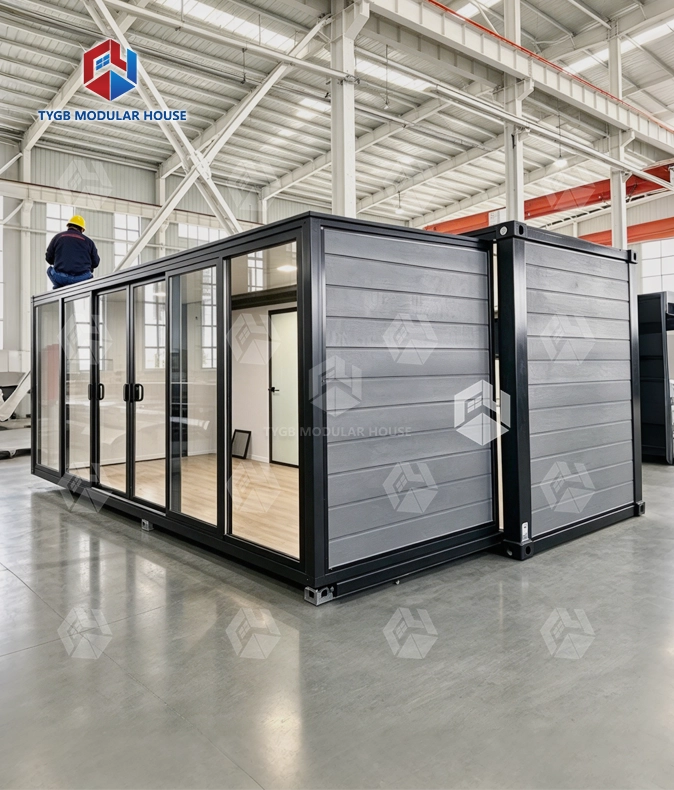
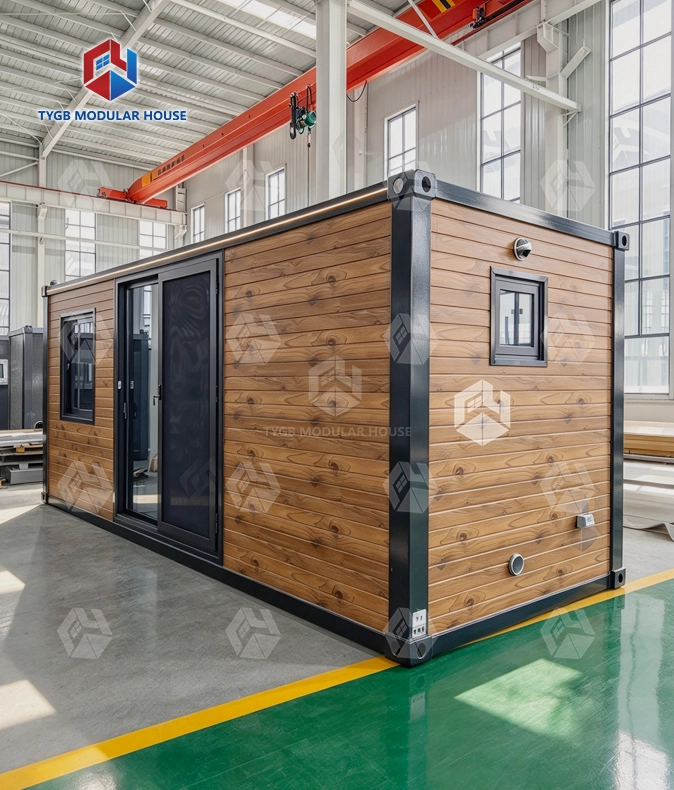
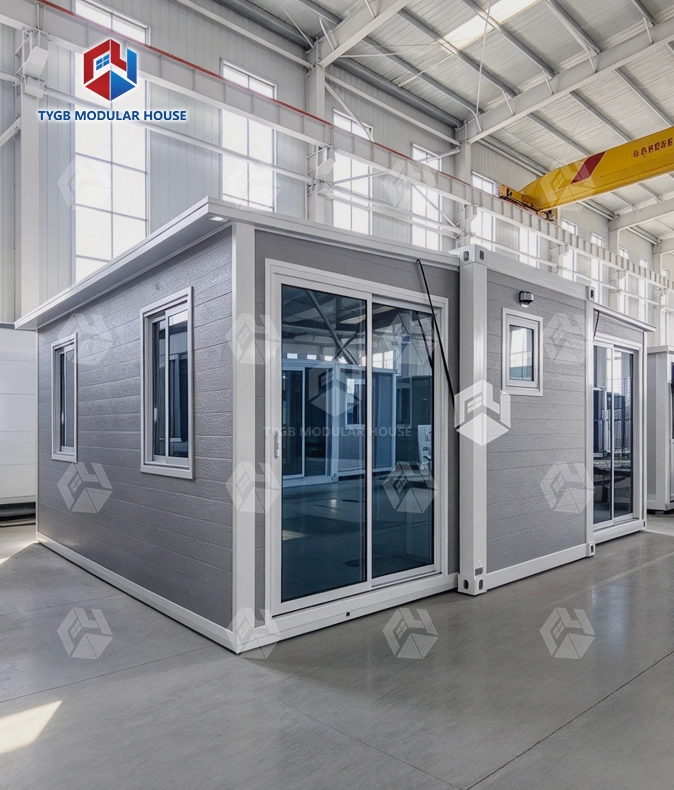
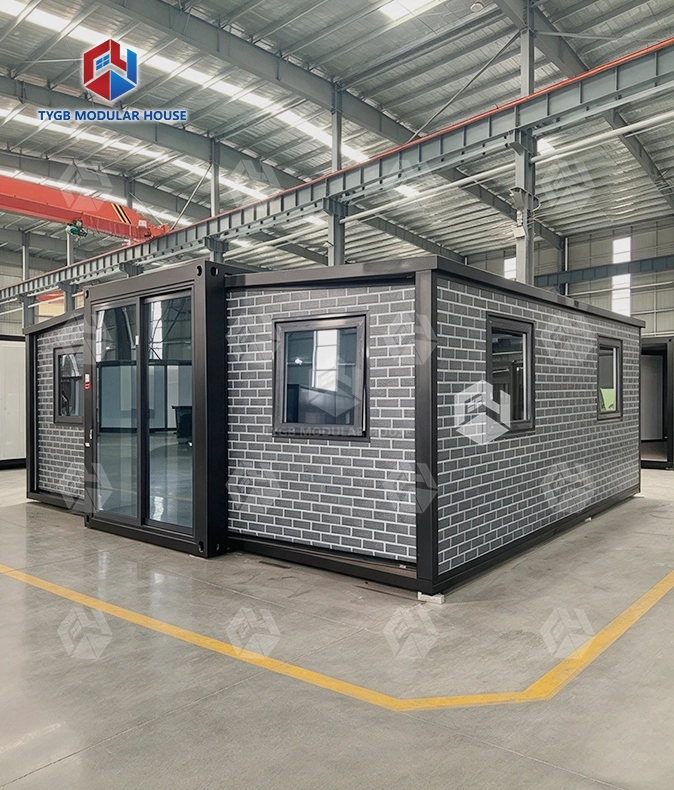
Our normal flat pack container home is 6055 x 2990 x 2896 mm once constructed. Its width and height are greater than the interior width and height of a normal dry container hence a whole unit cannot fit inside one. Flat packaging fixes it. The steel frame, sandwich panels, floor boards, doors and windows are sent in compact bundles and the workmen bolt them together on site. TYGB designed the home to an interior clear height of 2.4 m and to fit inside regular container loading constraints, so purchasers don't require flat-rack or open-top containers. The final count is a matter of configuration and we verify container amount against the particular model you want.

How to Calculate Flat Pack Container House Capacity?
Start with a Detailed Packing List and Payload Check
To get a good estimate for a flat pack container house, you will need to start by creating a packing list that contains the dimensions, gross weight, identification number, stacking limit and loading orientation for each bundle. To calculate the volume of a container, multiply the interior length, breadth and height together and compare the footprints of the bundles to the floor space available. Theoretical volume is seldom useable space. Irregular forms, protection gaps, non-stackable goods and lashing gear leave empty pockets. Compare overall cargo weight versus container payload limits, road laws and carrier needs. The CTU Code of IMO, ILO and UNECE provides recommendations on how to pack and secure goods. Request top view and side view loading diagrams as well.
What Determines the Number of Sets per Shipment?
The count is not just by floor space, but by the whole setup. Kitchens, baths, appliances, furnishings and electrical systems add mass and weight. The materials are different, as well. Each steel column and beam, 75 mm rock wool EPS sandwich panels, 18 mm MGO floor boards and window units have their own density and packing requirements. Our typical home is comprised of light steel ceiling, sandwich board partition walls, 2 mm PVC flooring, door and windows therefore it is important for purchasers to check whether a bid contains that whole set. Custom size, layout or finishes OEM/ODM support may adjust package sizes. In each quote, it should be clearly stated what constitutes a full dwelling set.
Worked Example: Estimating Capacity Without Overpromising
Below values are hypothetical and for planning purposes only - they are not TYGB packing data. A 40ft High Cube container has an interior capacity of about 76 m³ (12.03 x 2.35 x 2.69 m). The theoretical maximum is seven sets if a whole set fits within 10 m³ of bundles. Typically gaps, protecting space and non-stackable items will cut into that amount, so a planner may predict six. Then increase the specified weight by six and compare to the payload limit. Write the result as a model-specific figure, such as "X complete sets per 40-foot High Cube." Until the loading diagram from the supplier verifies it, treat it as an estimate.
Flat Pack Container House Shipping: Standard Container Versus Other Options and Cost
Flat Pack, Modular, Prefab, and Converted Container Homes
The phrases relate to distinct logistical models. Flat pack systems are delivered in tiny bundles, making them ideal for distant or inaccessible areas. Volumetric modular pieces come more complete, but need greater transport equipment, lifting capability and route design. "Prefab" is a catchall word that might represent panel systems, frame kits or entire modules, therefore compare real packing dimensions and weight, not marketing jargon. Converted shipping container houses utilize steel freight containers and varies in thermal efficiency, construction and floor design. The correct decision relies on climate, local legislation, available installation resources and final project cost. Compact bundles also need less warehouse and yard space than complete devices.
How Shipping Capacity Affects Landed Cost?
Factory pricing for a flat pack container house is merely a portion of the budget. Landed cost also covers packaging, inland transit, ocean freight, insurance, port costs, customs taxes, local delivery, equipment rental, installation, foundations, utilities and inspections. Poor utilization of containers increases cost per unit and per square meter, even if the ex-factory price seems inexpensive. Freight costs are usually greater per unit on a modest trial purchase. Bigger orders provide greater space for production planning, container filling and spare-parts allocation. Importers should be aware of port fees and tariffs. They should consult a qualified customs broker to determine the current duty rates, which are based on the product classification.
Using Incoterms to Compare Quotations
On the same trade conditions quotes are merely comparable. The Incoterms 2020 of the International Chamber of Commerce outlines who pays for and who transports the goods at each point of the journey for terms such as EXW, FOB, CIF and DDP. An FOB quotation is to the origin port, CIF includes ocean freight and insurance to a designated destination port. Ask the provider to provide you a breakdown of what the price covers – sets per container, optional parts, unloading, etc. Separated lines for kitchens, toilets and spare components avoid surprises. TYGB has independent import and export rights, and provides installation instructions in many languages, accessory lists, certifications, and test results with export orders.
How to Choose a Flat Pack Container House Supplier for Efficient Shipping?
Ask for Proof of Export Packing Experience
Look beyond the product images. Request past packing lists, container schematics, gross weight records and loading pictures or video. They reveal whether a provider can schedule a load, or only manufacture a unit. Also check the manufacturing capacity. Hebei Tianyu Guangbo Integrated Housing Co., Ltd. has produced modular buildings for over 10 years. We have two automated manufacturing lines, a factory of more than 30,000 m², we create more than 3,000 pieces each year and sell in more than 50 markets. The complex comprises a welding workshop, a painting and spraying workshop, a spare-parts area and CNC shaping and bending machinery. Buyers may see in person or via video conference.
Check Compliance and Test Documents
Compliance documentation is sometimes the deciding factor in whether a project gets to go forward. Request for certifications and test reports that apply to your target market. TYGB carries ISO 9001, ISO 14001 and ISO 45001 certifications, CE for the EU, SAA and Watermark for Australia and New Zealand. We also give SGS, Intertek and CNAS recognized test reports for wind, earthquake, fire, sound insulation and waterproofing. The typical home has Class A fire resistance, level 8 seismic resistance, 0.50 kN/m wind load, and Waterproofing Level 2. EU purchasers should additionally check whether Regulation (EU) No 305/2011 applies to their import. The ultimate say rests with the local authorities.
Plan the Load Before Production
Good loading for a flat pack container house begins with design. Smaller hardware boxes, standard panel widths and fewer empty voids mean you may utilize more containers without compromising security. It separates key structural items from optional furnishings, appliances and spare components so each shipment may be customized to project requirements. Simple 2D design, barcode labels and weight distribution checks cut loading mistakes. TYGB employs ocean-grade shock-resistant packing and the galvanized Q345 steel frame is corrosion resistant. Reinforced cast iron corner fittings at top and bottom withstand deformation during repeated loading/unloading. ISO 1161 is the standard for corner fittings for freight containers and it is important questioning any provider about this aspect.
Buyer's Checklist Before Ordering Flat Pack Container Houses
Product and Performance Questions
Compare price, sure, but look at the technical points first. Ask for installed and packed dimensions, bundle counts, gross weight and service life of the frame and panels. Insulation check. Our wall and roof are made of 75 mm thick rock wool EPS sandwich panels, thermal conductivity 0.043 W/(m·K), sound insulation not less than 30 dB. Review waterproofing, corrosion protection and ground live load of 2.0 kN/m. Check the list of replacement components. TYGB supplies maintenance manuals, spare part lists and the availability of genuine replacement parts over the long term, which is important for rental fleets that need speedy repairs.
Shipping and Commercial Questions
Then validate the suggested container type, the actual number of sets per container, and what is included in each set. Ask about loading schematics and who handles packing, loading and unloading. On the business side, check Incoterm, delivery time, warranty, certifications, OEM possibilities and replacement part cost. Have the provider write down its minimum order quantity. TYGB wait time is 4-5 weeks depending on order amount. We take both mass production and small batch bespoke orders. The frame has a 36-month guarantee while sections subject to wear and tear have a 10-month warranty.
Installation, Reuse, and Rental Economics
The plan should cover installation charges. The frame is bolted together with M12×40 high-strength bolts. No welding is involved. Assembly typically takes 1–2 days without heavy gear. The home may be taken apart and reused many times. Rental operators can transfer units from site to site and amortize the purchase cost across several leases. Look at foundations, labor, permits, wind and snow loads, and electrical and plumbing codes at the location. In the pre-sales stage, our engineers will study the local climate conditions and laws. We will provide illustrated manuals, video guides and online engineer help. Seasonal demand is also important, so inquire whether the supplier can break a big order into many shipments.
Conclusion
If you are looking for how many flat pack container house units fit in a shipping container there is no one figure. Capacity will depend upon the size of the packed bundle, gross weight, kind of container, stacking limitations and the contents of each full set. The container measurements are a starting point, but a complete packing list, payload check and loading diagram convert that estimate into something useable. Landed cost is also a function of the shipping capacity so buyers should compare quotes on the same Incoterm and consider the overall project cost and not simply the factory pricing. Supplier proof, compliance papers, installation requirements and spare-part support complete the image. Structure, insulation and assembly details all play a role in these choices, like in the TYGB standard home that ships flat and bolts together on site. A confirmed strategy provides a better foundation for budgeting and scheduling.
FAQ
Q1: How many flat pack container houses fit in a 40-foot container?
A: It depends on the model, bundle size, weight, and included parts. A 40-foot High Cube adds height but does not guarantee a fixed number. Ask for a model-specific packing list.
Q2: Do I need a flat-rack or open-top container?
A: No. TYGB designs the home to have a 2.4 m interior clear height, and within normal container loading constraints, thus standard containers operate.
Q3: How long does assembly take?
A: Assembly usually takes 1–2 days. Crews use M12×40 high-strength bolts, with no welding or heavy machinery.
Q4: Can I customize size and layout?
A:Yes. OEM/ODM assistance for size, layout and finishes is available. Our engineers will prepare floor plans and 3D representations, provide you with a quote and update designs till your approval. 36-month warranty covers the frame.
Request a Flat Pack Container House Loading Plan from TYGB
TYGB is a flat pack container house manufacturer with two automated production lines, AU/NZS approvals, and a 36-month frame warranty. Send us your preferred model, quantity, destination port, and required features, and our engineers will prepare a quotation and a model-specific container loading plan. Email paulpan@tygbhouse.com to start your project.
References
1. ISO 668: Series 1 Freight Containers – Classification, Dimensions and Ratings, 2020
2. ISO 1496-1: Series 1 Freight Containers – Specification and Testing, Part 1, 2013
3. ISO 1161: Series 1 Freight Containers – Corner and Intermediate Fittings – Specifications, 2016
4. IMO/ILO/UNECE Code of Practice for Packing of Cargo Transport Units (CTU Code), 2014
5. Incoterms 2020 Rules, International Chamber of Commerce, 2019
6. Regulation (EU) No 305/2011 Laying Down Harmonised Conditions for the Marketing of Construction Products, European Union, 2011